Intelligent personal mobility
Combines voice, eye, head, phone and joystick inputs under adaptive supervision and safety.
View facilities & explanationsInside the space,
the details take shape.
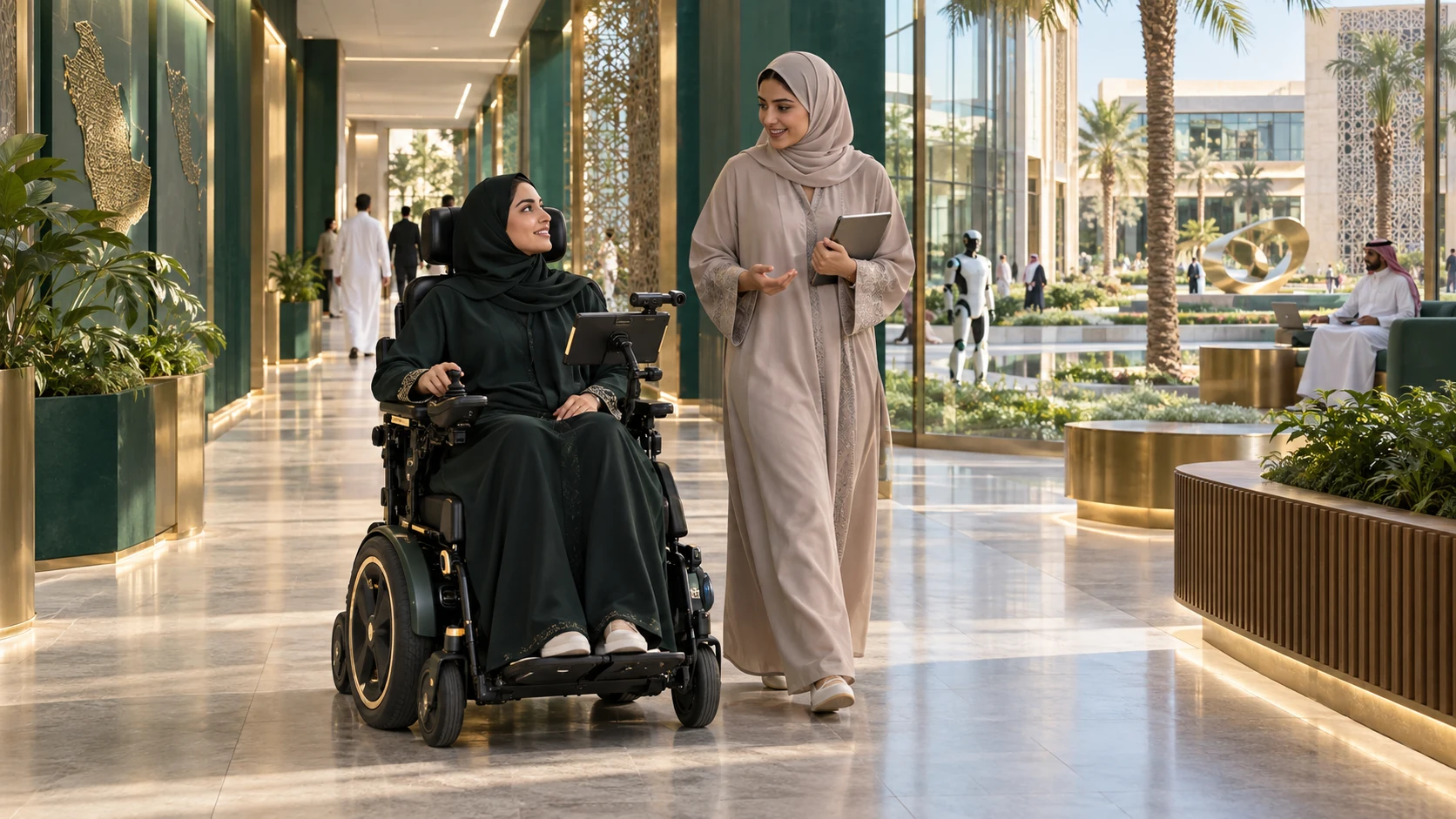
The concept centers on a mobility chair whose input methods can be configured to the user’s abilities and preferences. A clear joystick is complemented by proposed voice, eye, head and phone interfaces, with a single layer governing command priority and movement limits. Evaluation starts with stationary training, then supervised limited movement in an accessible corridor.
An unobstructed accessible route with clear stopping points
Reachable controls and understandable user feedback
A configuration and training area for the user and companion
Every unit, explained.
Every facility is explained below. Use the index to jump directly to a facility.
Input configuration
Select a suitable input, adjust sensitivity and document the user’s ability to activate and stop it.
A reviewable configuration profile.
Command coordination
Prioritize signals, resolve conflicts and show the active input instead of combining contradictory movement commands.
A movement command with a known source and state.
Movement supervision
Define movement, stopping, signal-loss and obstacle behavior within bounded test scenarios.
A movement and stopping test record.
User evaluation & training
Evaluate feedback clarity, learnability and companion intervention in an authorized supervised trial.
Usability findings and an improvement plan.
From intake to outcome.
An illustrative route linking the units and showing how work moves between them.
Understand use
Define the user’s needs, movement environment and companions.
- 01
Understand use
Define the user’s needs, movement environment and companions.
- 02
Configure
Select controls and limits and train the user.
- 03
Stationary trial
Review response and stopping before movement.
- 04
Bounded movement
Run a short supervised route and record exceptions.
- 05
Refine
Adjust configuration from findings and reassess.
Intelligent personal mobility
The image proposes a relationship between work areas, circulation and service. Zones and materials can evolve; it does not establish engineering dimensions or approved final equipment.
How does the concept work in practice?
Switching input methods
A user begins with the joystick and then tries an alternative input while stationary. The interface shows the active mode, and stopping is checked before continuing.
An understandable, reviewable transition between controls.
Clear ownership. Documented outputs.
Interaction & accessibility
Designs controls with users and reviews clarity.
Motion & systems engineering
Develops command coordination, stopping behavior and tests.
Specialist evaluation
Defines evaluation conditions and participant suitability.
What does this area deliver?
01Input configuration profile
02Conflict and stopping test record
03Usability and improvement report
What is reviewed before operation?
01Clear active input and stopping priority
02Verify signal-loss and conflicting-command behavior
03Evaluate suitability before user trials
Proposed review areas, not a readiness certificate or operating approval.Connected to the wider city.
Continue into the detailed pages of related facilities and systems.